


Application of road markings - horizontal and vertical road markings, designations, DSTU
A beautiful parking lot and roads is a visiting card of any company and any country.
The marking is applied with road reflective paint, which contributes to resistance to weather conditions, sufficient visibility at night and when hitting the marking, it is not erased.

Road marking in the parking lot allows you to designate parking spaces for cars for the most efficient use of parking spaces. Road markings separate traffic lanes, guide and ensure traffic safety.
Application of road markings
Road markings - lines, arrows and other signs on the carriageway, road structures and elements of road equipment. Provides visual orientation of road users when choosing a trajectory, direction and modes of movement in different road conditions.
1. Horizontal markings
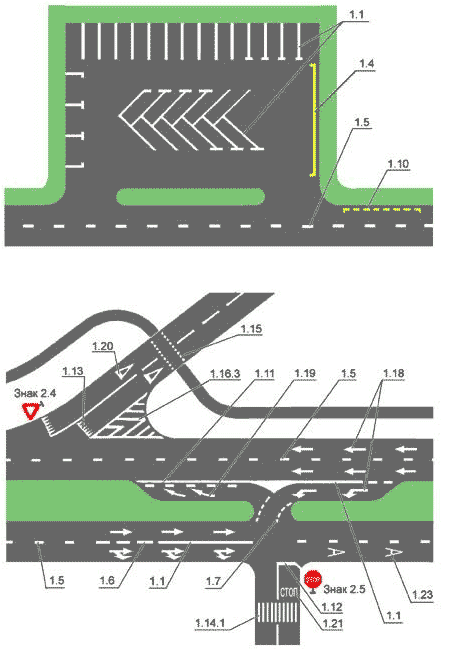
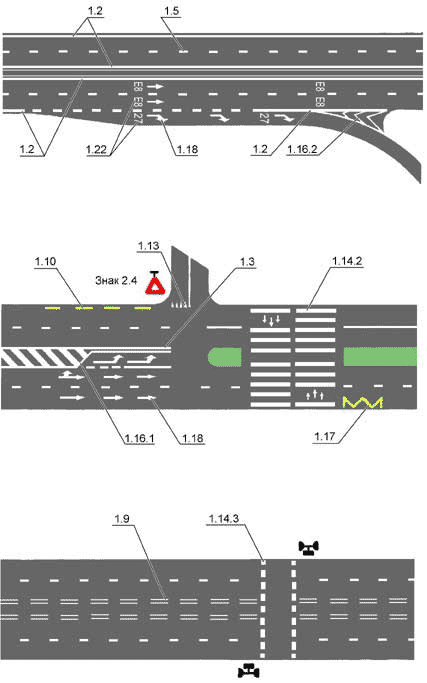
Horizontal road markings have the following meaning:
1.1 (narrow solid line) - separates traffic flows in opposite directions and marks the boundaries of traffic lanes on the roads;
indicates the boundaries of the carriageway, entry to which is prohibited;
designates the boundaries of parking places and the edge of the carriageway of roads that are not classified as motorways according to traffic conditions;
1.2 (wide solid line) - indicates the edge of the carriageway on motorways or the border of the lane for the movement of route vehicles. In places where other vehicles are allowed to enter the lane of route vehicles, this line may be intermittent;
1.3 - separates traffic flows of opposite directions on roads with four or more lanes;
1.4 - indicates places where stopping and parking of vehicles is prohibited. It is used alone or in combination with sign 3.34 and is applied at the edge of the carriageway or along the top of the curb;
1.5 - separates traffic flows of opposite directions on roads with two or three lanes, marks the boundaries of lanes in the presence of two or more lanes intended for movement in one direction;
1.6 (approach line - a dashed line, in which the length of the strokes is three times the intervals between them) - warns of approaching markings 1.1 or 1.11, separating traffic flows of opposite or passing directions.
1.7 (dashed line with short strokes and equal intervals) - indicates traffic lanes, as well as the direction of the main road within the intersection;
1.8 (wide dashed line) - indicates the border between the acceleration or deceleration lane and the main lane of the carriageway (at crossroads, road intersections at different levels, in the area of bus stops, etc.);
1.9 - indicates the boundaries of traffic lanes on which reverse regulation is carried out; separates traffic flows of opposite directions (when reverse traffic lights are off) on roads where reverse regulation is carried out;
1.10 - indicates places where parking is prohibited. It is used alone or in combination with sign 3.35 and is applied at the edge of the carriageway or along the top of the curb;
1.11 - separates traffic flows of opposite or passing directions on road sections where rebuilding is allowed only from one lane; indicates places intended for U-turns, entry and exit from parking areas, etc. where traffic is allowed only in one direction;
1.12 (stop line) - indicates the place where the driver must stop in the presence of a sign 2.2 or with a prohibitory signal from a traffic light or a traffic controller;
1.13 - indicates the place where the driver must, if necessary, stop and give way to vehicles moving on the crossed road.
1.14.1, 1.14.2 ("zebra") - denotes an unregulated pedestrian crossing; marking arrows 1.14.2 indicate the direction of movement for pedestrians;
1.14.3 - indicates a pedestrian crossing where traffic is regulated by a traffic light;
1.15 - indicates the place where the cycle path crosses the carriageway;
1.16.1, 1.16.2, 1.16.3 - designates guide islands in places of division, branching or confluence of traffic flows;
1.17 - indicates the stops of route vehicles and taxis.
1.18 - indicates the directions of traffic on the lanes allowed at the intersection. Used alone or in combination with signs 5.16, 5.18; dead end markings are applied to indicate that turning onto the nearest carriageway is prohibited; markings that allow a left turn from the leftmost lane also allow a U-turn;
1.19 - warns of approaching a narrowing of the carriageway (a section where the number of lanes in a given direction decreases), or to a marking line 1.1 or 1.11, which separates traffic flows in opposite directions. In the first case, it can be used with signs 1.5.1, 1.5.2, 1.5.3;
1.20 - warns about approaching marking 1.13;
1.21 (the inscription "STOP") - warns of approaching the marking 1.12, if it is used in combination with the sign 2.2;
1.22 - indicates the number of the road (route);
1.23 - indicates a lane intended for the movement of route vehicles only.
Lines 1.1 and 1.3 are not allowed to be crossed. If the line 1.1 indicates a parking place or the edge of the carriageway adjacent to the roadside, it is allowed to cross it.
As an exception, subject to ensuring road safety, it is allowed to cross line 1.1 to bypass an immovable obstacle, the dimensions of which make it impossible to safely bypass it without crossing this line, as well as to overtake single vehicles moving at a speed of less than 30 km / h .
Line 1.2 is allowed to be crossed in case of a forced stop, if this line marks the edge of the carriageway adjacent to the shoulder.
Lines 1.5 and 1.8 are allowed to be crossed from either side.
On the section of the road between reversing traffic lights, line 1.9 is allowed to be crossed if it is located to the right of the driver.
When green signals are turned on in reversing traffic lights, line 1.9 is allowed to be crossed from any side if it separates the lanes on which traffic is allowed in any direction. When turning off the reversing traffic lights, the driver must immediately change lanes to the right beyond the marking line 1.9.
Line 1.9, located on the left, is prohibited to cross when reverse traffic lights are turned off.
Line 1.11 is allowed to be crossed for overtaking (bypassing an obstacle) only from the side of its intermittent part, and from the solid side - only for overtaking or avoiding an obstacle.
2. Vertical markings
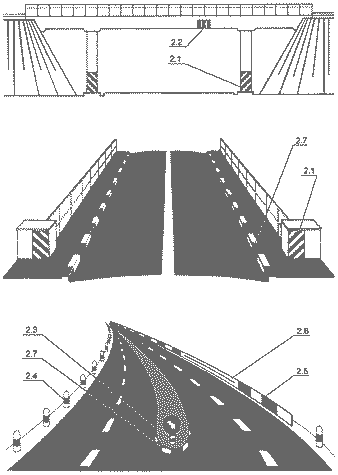
2.1 - elements of road structures (supports of bridges, overpasses, end parts of parapets, etc.);
2.2 - the lower edge of the superstructure of tunnels, bridges and overpasses;
2.3 - round pedestals installed on dividing strips or safety islands;
2.4 - guide posts, gouges, barrier supports, etc.;
2.5 - side surfaces of road barriers on curves of a small radius, steep slopes, and other dangerous areas;
2.6 - side surfaces of fences in other areas;
2.7 - curbs in dangerous areas and towering safety islands.
Application of road markings in the town:
Territory marking, parking space marking, road marking, courtyard marking, parking lot marking, parking marking, garage marking, underground parking marking, tennis court marking, playground marking, playground marking, parking zone marking, supermarket and shop marking.


